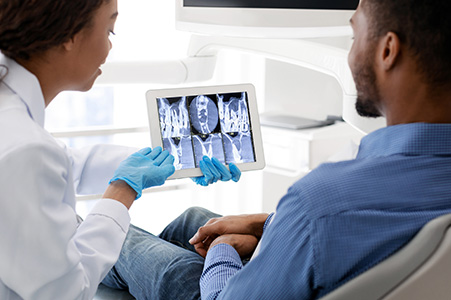
 Cone Beam Computed Tomography, commonly known as CBCT, is an advanced imaging technology that provides highly detailed three-dimensional views of the teeth, jaw, and surrounding structures. Traditional medical CT scans have long been used in healthcare to generate cross-sectional images of the body. In dentistry, CBCT offers similar benefits but is specifically designed for the oral and maxillofacial region, allowing precise visualization of bone, nerves, tooth roots, and soft tissues in a single scan.
Unlike standard dental radiographs, CBCT captures comprehensive three-dimensional data in less than thirty seconds. The focused cone shaped beam rotates around the patient’s head, collecting hundreds of images that are reconstructed into a detailed digital model. The process is quick, comfortable, and exposes patients to a low level of radiation compared with many conventional imaging methods.
One of the primary applications of CBCT is dental implant planning. Successful implant placement depends on accurate assessment of bone height, width, and density, as well as the exact location of vital structures such as nerves and sinuses. With CBCT technology, clinicians can determine ideal implant size, angulation, and position before surgery begins. This advanced planning improves precision, enhances safety, and often reduces overall treatment time.
CBCT is also valuable for diagnosing impacted teeth, identifying infections, evaluating jaw abnormalities, detecting cysts or tumors, and assessing complex root canal anatomy. The ability to view thin cross-sectional slices of the jaw enables early detection of conditions that may not be visible on traditional two-dimensional images. In many cases, this clarity leads to more accurate diagnoses and better informed treatment decisions.
By integrating CBCT into patient care, dental practices improve efficiency, reduce uncertainty, and enhance surgical outcomes. The technology supports every phase of treatment, from initial diagnosis to final restoration, ultimately saving time and helping patients receive more predictable and effective care.


